Key takeaways
- A year-end accounting checklist keeps you from missing the steps that cause tax-season headaches: reconciliations, payroll and 1099 reporting, inventory, fixed assets and sales tax.
- Start in October or November, not the last week of December.
- For 2026 calendar-year businesses, Forms W-2 and 1099-NEC are due by Monday, February 1, 2027.
- Clean, reconciled books are the best thing you can hand your CPA, and they make next year's decisions easier.
For a small business owner, year-end shows up in the middle of customer work, payroll, invoices and plans for next year. Reviewing the books easily becomes a last-minute job. But year-end accounting is more than closing the ledger. It's your chance to fix errors, see how the year really went, and give your tax professional records they can rely on.
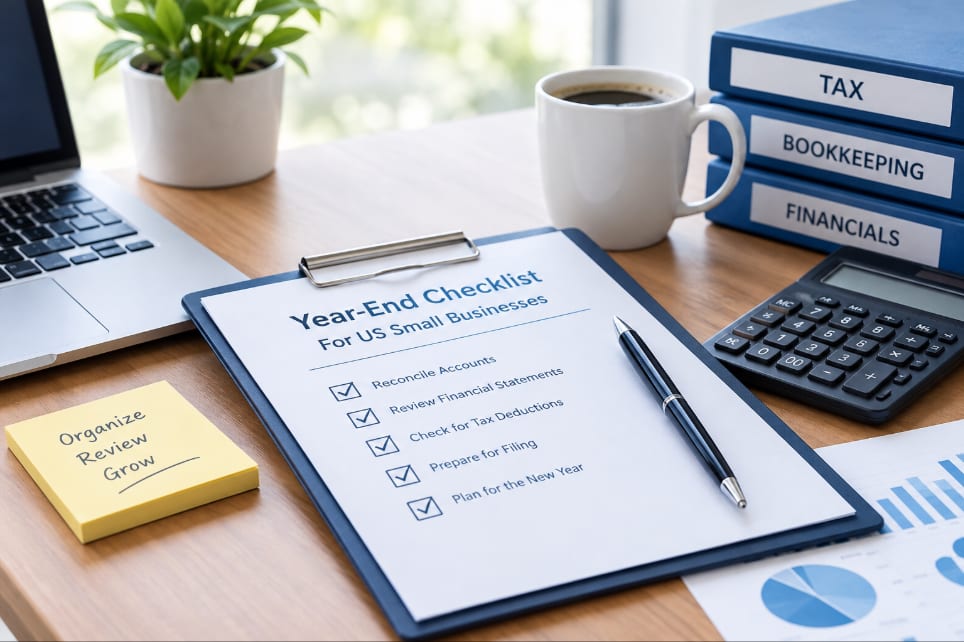
A consistent process helps US small businesses prepare for tax filing, make better cash-flow decisions and start January with cleaner books. Use this year-end accounting checklist with your bookkeeper or accountant, and work through it in order.
Short answer: A small business year-end close has nine core steps: reconcile all accounts, review income and expenses, confirm receivables and payables, check payroll and W-2/1099 reporting, count inventory, update fixed assets and depreciation, verify sales tax and other liabilities, review financial statements with your CPA, and organize records for the new year.
Year-End Deadlines for 2026 at a Glance
These are the federal dates most calendar-year small businesses plan around. State deadlines vary, so add yours before you start the rest of your year-end accounting checklist.
| Date | What's due | Who it applies to |
|---|---|---|
| Oct to Nov 2026 | Start year-end prep: reconciliations, W-9 collection, inventory count planning | All businesses |
| Dec 31, 2026 | Fiscal year ends; purchases for 2026 deductions must be placed in service | Calendar-year businesses |
| Jan 15, 2027 | Q4 2026 estimated tax payment | Owners and businesses paying estimates |
| Feb 1, 2027 | Forms W-2 to employees and SSA; Form 1099-NEC to recipients and IRS (Jan 31 falls on a Sunday) | Employers and businesses paying contractors |
| Mar 15, 2027 | Form 1120-S (S corp) and Form 1065 (partnership) returns or extensions | S corporations and partnerships |
| Apr 15, 2027 | Form 1120 (C corp) and individual returns, including Schedule C, or extensions | C corporations, sole proprietors, single-member LLCs |
The 9-Step Year-End Accounting Checklist
1. Reconcile every bank, credit card and loan account
Reconcile all business bank accounts, credit cards, lines of credit and loans through the final month of the fiscal year. Compare the books with the statements and investigate differences rather than posting an adjustment just to make the balances agree.
Review outstanding checks, deposits in transit, duplicate bank-feed entries, fees, interest and transfers between accounts. For loans, agree the balance to the lender's statement and split principal from interest. Completed reconciliations are the foundation of everything else on this list. If your feeds keep breaking, a proper bank feed setup saves hours every month, and our monthly bookkeeping checklist shows how to stay reconciled all year.
2. Review income and expense transactions
Scan the general ledger for uncategorized, unusual, duplicate or personal transactions. Check that income is recorded in the correct period and expenses are coded consistently. Pay close attention to owner contributions and draws, reimbursements, meals, travel, vehicle costs and large purchases.
Keep receipts, invoices and a short business-purpose note where it matters. That documentation explains transactions later and gives your tax preparer context. Remember, a book expense isn't automatically tax-deductible; the treatment depends on the facts and current rules. If personal and business spending are tangled together, our guide to personal vs. business tax returns explains why separating them matters, and a QuickBooks cleanup can untangle the ledger.
3. Confirm accounts receivable and accounts payable
Run the accounts receivable aging report and follow up on overdue invoices. Decide whether old balances are collectible, disputed or need a closer look. Apply customer credits, refunds and payments to the right invoices.
Then review accounts payable for late-arriving bills, duplicates and outstanding payments. Request vendor statements when balances don't agree. Accurate receivables and payables prevent cash-flow surprises and support dependable year-end reporting. If chasing invoices eats your week, consider outsourced accounts payable and receivable support.
4. Check payroll, benefits and W-2/1099 reporting
Compare payroll reports with the general ledger. Verify wages, employer payroll taxes, benefits, retirement contributions and payroll liabilities. Confirm that quarterly Forms 941 and state filings agree with your payroll provider's records, and investigate any balance still sitting in a liability account. Our payroll compliance team runs this check every year end.
Next, prepare for information reporting: Forms W-2 for employees and Forms 1099-NEC or 1099-MISC for qualifying payments to contractors and landlords. Collect a Form W-9 from every vendor you might need to report, now rather than in late January. A few changes matter for 2026:
- Higher 1099 threshold. Under the 2025 federal tax law, the reporting threshold for Forms 1099-NEC and 1099-MISC rose from $600 to $2,000 for payments made after December 31, 2025.
- Form 1099-K. Payment apps and marketplaces are back to the $20,000 and 200-transaction threshold, so many small sellers won't receive one. Your sales are still taxable either way.
- E-filing. If you file 10 or more information returns in total (W-2s and 1099s combined), you generally must file them electronically.
Requirements change, so confirm current IRS and state instructions with your payroll provider or tax professional. Juris CFO handles W-2 preparation and 1099 preparation if you'd rather not.
5. Review inventory and cost of goods sold
If you hold inventory, plan and document a year-end count as close to December 31 as you can. Compare counted quantities with your inventory system, write down damaged or obsolete items, and review how costs are recorded. Keep the treatment of purchases, freight and other costs consistent with your accounting method.
Retailers and e-commerce sellers should reconcile marketplace and payment-processor activity (Amazon, Shopify, Stripe, PayPal) to deposits, fees, refunds, sales tax and revenue. A payout is not the same as sales: the deposit you see is what's left after fees and refunds. Getting this wrong misstates both income and cost of goods sold. We cover this in more detail for e-commerce and DTC brands.
6. Review fixed assets, equipment and depreciation
List purchases and disposals of equipment, computers, furniture, vehicles and other long-term assets. Record significant purchases correctly and remove anything sold, scrapped or retired. Keep invoices, purchase and in-service dates, and business-use percentages.
Ask your accountant to review the fixed asset schedule and the depreciation options available to you. Under current federal law, 100% bonus depreciation is back for qualifying property acquired after January 19, 2025, and the Section 179 expensing limit increased. Many small businesses can also use the de minimis safe harbor to expense items up to $2,500 per invoice or item. Still, don't assume a large purchase should be fully expensed just because you paid for it this year; book and tax treatment can differ, and state rules don't always follow federal ones.
7. Verify sales tax, loans and other liabilities
Compare sales tax collected and payable by state and jurisdiction with the returns you filed and the payments you made. Review accrued expenses, customer deposits, gift cards, payroll liabilities and unpaid interest. Agree loan balances to lender statements and separate current and long-term portions where required.
If you sell across state lines or through online marketplaces, you may have obligations in states where you have no office. Since the 2018 South Dakota v. Wayfair decision, most states use economic nexus thresholds based on sales or transactions. Raise questions about registrations, filings or odd balances before closing the year, and lean on sales tax compliance help if you've crossed new thresholds. While you're at it, check that your state annual reports and business licenses are current.
8. Review financial statements and plan for taxes
After reconciliations, prepare the profit and loss statement, balance sheet and, if available, the cash flow statement. Compare the results with last year and your budget. Investigate unexpected movements in gross margin, expenses, receivables, debt or cash, and make sure the records explain them. Not sure what you're looking at? Start with how to read your profit and loss statement.
Share the financial statements and supporting schedules with your CPA early, ideally in December rather than March. Talk through the January 15 estimated payment, owner compensation where it applies, retirement contributions, planned purchases and any changes to the business. Tax rules depend on entity type and circumstances, so use this meeting to surface questions rather than assume a deduction applies. Our tax services and CFO services teams can help with planning.
9. Organize records and set up the new year
Store bank statements, invoices, receipts, payroll reports, tax filings, loan statements, inventory records and asset documents securely. The IRS generally asks you to keep records for at least three years after you file, at least four years for employment tax records, and longer in some cases, such as records for assets you still own. States may have their own rules.
Then carry forward reconciled balances, review recurring transactions and bank rules, remove old user access, and set a monthly close deadline. Lock the prior year in your accounting software with a closing date and password so no one edits it by accident. A short monthly close is far easier than rebuilding a full year of activity, which is why many owners move to monthly bookkeeping. An internal controls review is also worth doing once your books are clean.
Common Year-End Accounting Mistakes to Avoid
Even with a year-end accounting checklist in hand, these slip through more often than you'd think:
- Trusting bank feeds without reconciling. Feeds miss transactions and create duplicates. Reconciliation is what proves the balance.
- Recording payouts as revenue. Gross sales, fees and refunds each need their own line.
- Waiting until January to collect W-9s. Missing taxpayer IDs delay 1099s and can trigger penalties.
- Mixing personal and business spending. It inflates expenses, weakens records and complicates your return.
- Forgetting accruals. December work billed in January, or bills that arrive late, can distort the year.
- Leaving the prior year unlocked. One accidental edit in March can change numbers your CPA already used.
What If Your Books Are Months Behind?
It happens more often than owners admit. If several months haven't been reconciled, don't try to rush everything in the last week of December. The year-end accounting checklist still works; you just tackle it in a stricter order. Start with the bank and credit card reconciliations, then income, then payroll. Bring in catch-up bookkeeping help if you're more than two or three months behind, so your CPA isn't working from estimates. If this keeps happening every year, it may be time to outsource your accounting so the year-end close becomes a review instead of a rescue mission.
Printable Small Business Year-End Checklist
Use this one-page small business year-end checklist as a summary of the full year-end accounting checklist above. Print it, assign an owner to each line, and tick it off as you go.
| # | Task | Owner | Done |
|---|---|---|---|
| 1 | All bank, credit card and loan accounts reconciled to Dec 31 | Bookkeeper | [ ] |
| 2 | Uncategorized, personal and duplicate transactions cleared | Bookkeeper / owner | [ ] |
| 3 | AR aging reviewed; AP and vendor statements agreed | Bookkeeper | [ ] |
| 4 | Payroll tied to GL; W-9s collected; W-2s and 1099s ready | Payroll / bookkeeper | [ ] |
| 5 | Inventory counted; marketplace payouts reconciled | Owner / bookkeeper | [ ] |
| 6 | Fixed asset additions and disposals listed for CPA | Accountant | [ ] |
| 7 | Sales tax, loans and accrued liabilities verified | Accountant | [ ] |
| 8 | P&L, balance sheet and cash flow reviewed with CPA | Owner / CPA | [ ] |
| 9 | Records archived; prior year locked; monthly close set | Bookkeeper | [ ] |
Make Year-End a Process, Not a Scramble
Your year-end accounting checklist should fit your business. A service company may focus on receivables and payroll; a retailer may need more time for inventory and marketplace reconciliations. Work through the steps in the same order every year, keep support for important balances, and raise questions early.
Juris CFO is a US outsourced accounting firm that supports small businesses with bookkeeping, reconciliations and financial reporting, payroll and tax-ready books. Clean books make year-end easier and give owners a clearer view of the decisions ahead. Book a year-end review with our team.
Sources and Further Reading
- IRS, General Instructions for Certain Information Returns (Forms 1099)
- IRS, Instructions for Forms W-2 and W-3; IRS Publication 15 (Circular E), Employer's Tax Guide
- IRS Publication 946, How to Depreciate Property; IRS Publication 538, Accounting Periods and Methods
- IRS, How long should I keep records? (irs.gov)
- South Dakota v. Wayfair, Inc. (U.S. Supreme Court, 2018)
- Also on our site: bookkeeping workflow for accounting firms
This article is general information, not tax, legal or investment advice. Talk to our team about your specific situation.
Frequently asked questions
Start in October or November, several weeks before the fiscal year ends. Confirm who will provide records, resolve open questions and schedule reconciliations early so the final close is manageable.
Forms W-2 and 1099-NEC are normally due January 31. Because January 31, 2027 falls on a Sunday, the deadline for 2026 forms moves to Monday, February 1, 2027. Confirm current dates on IRS.gov.
Start with the profit and loss statement, balance sheet, and accounts receivable and payable aging reports. Bank reconciliations, loan schedules, payroll summaries, fixed asset schedules and inventory reports may also be needed.
Yes. Bank feeds save time but don't replace reconciliation. Duplicate or missing transactions and incorrect matches still happen. Agree each account to its statement and investigate differences.
The year-end close finalizes your books: reconciled accounts, correct balances and reliable financial statements. Tax filing uses those books to prepare returns. A clean close makes tax preparation faster and cheaper.
Keep support for income, expenses, payroll, assets, inventory, loans and prior filings. The IRS generally recommends at least three years, four for employment tax records, and longer for some items. Confirm federal and state requirements with your tax professional.
Yes. Set a closing date and password in your accounting software once the year is final, so later edits can't change numbers your CPA has already used.
A bookkeeper can organize records, reconcile accounts and prepare reports and schedules. Your CPA or tax professional advises on tax treatment and prepares or files returns as engaged. Agree on responsibilities in advance.