Key takeaways
- Outsourced accounting services let a small business hand some or all of its bookkeeping, reconciliations, payroll support and reporting to an outside team for a predictable fee.
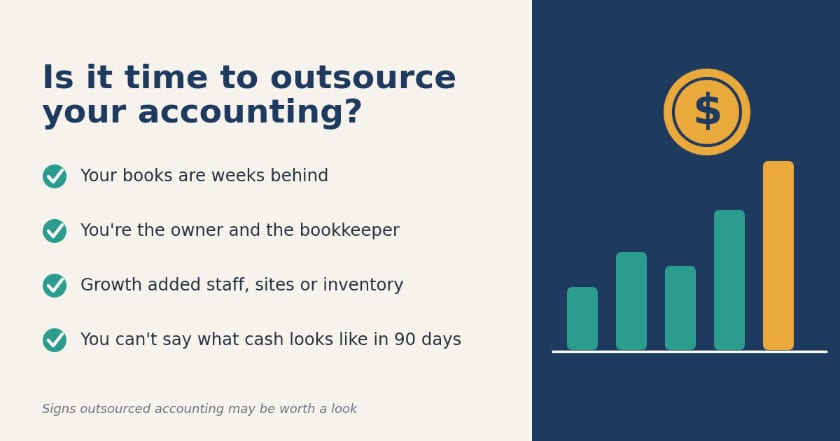
- The clearest signs it's time: books that run weeks behind, an owner doing reconciliations on weekends, growth into new states or headcount, repeat errors, and no reliable cash forecast.
- For most small companies it costs less than a full-time hire, but it doesn't remove your responsibility for the numbers.
- Start with one area for 60 to 90 days, measure turnaround and accuracy, then expand.
No one wakes up and decides to outsource their accounting. It creeps up on you in small, irritating moments. You're categorizing receipts at 11 p.m. A sales tax filing goes out a week late. Your bank asks for a profit and loss statement, and you realize the last month you reconciled was March.
If that sounds familiar, you're probably wondering whether outsourced accounting services for small businesses are actually worth it. This guide covers what outsourcing includes, the signs it's time, what it costs, when it's the wrong call, what the first 90 days look like, and how to choose a partner you can trust with your numbers.
Short answer: If your books are more than a few weeks behind, you're spending several hours a week on bookkeeping, or you've grown into payroll, inventory or multistate sales tax, it's probably time to outsource at least part of your accounting. If you have only a handful of transactions a month and you're comfortable in your software, you can likely wait.
What Are Outsourced Accounting Services?
Outsourced accounting services are financial tasks handled by an outside firm instead of an employee on your payroll. The scope is flexible. Some owners hand over only outsourced bookkeeping, like data entry and reconciliations. Others pass along the whole function:
- Bookkeeping and monthly bank and credit card reconciliations
- Accounts payable and accounts receivable, including bill pay and collections follow-up
- Payroll processing support and payroll tax filing reconciliation
- The month-end close and monthly financial statements
- Sales tax compliance records and tax-ready books for your CPA
- Higher-level help such as controller services or a part-time CFO
You decide how much to keep close and how much to send out. Most small businesses start with bookkeeping and add pieces as they grow.
Outsourced Bookkeeping vs. Accounting vs. CFO Services: What's the Difference?
These terms get used interchangeably in small business accounting, but they aren't the same service, and the difference affects what you pay and what you get. Here's a plain-English breakdown:
| Service level | What it covers | Best for |
|---|---|---|
| Outsourced bookkeeping | Recording and categorizing transactions, bank and card reconciliations | Owners who need clean, current books |
| Outsourced accounting | Bookkeeping plus month-end close, accruals, financial statements, payroll and sales tax support | Growing companies with staff, inventory or lenders |
| Controller services | Oversight of the close, internal controls, review of an in-house bookkeeper's work | Businesses that have a bookkeeper but need a reviewer |
| Fractional or virtual CFO | Cash forecasting, budgets, pricing, financing and growth decisions | Owners facing bigger strategic calls |
If you're unsure which tier fits, our service comparison page lays them side by side. For deeper dives, read our posts on outsourced bookkeeping services and virtual CFO services.
6 Signs It's Time to Outsource Your Accounting
- Your books are always behind. If last month's numbers show up in week three or four of this month, you're steering by old information.
- You're the bookkeeper, and it's costing you. Every weekend spent on reconciliations is a weekend not spent on sales, customers or rest.
- Growth has added complexity. A new location, new employees, inventory, or sales into other states can turn simple books into a real job. Since the Supreme Court's 2018 South Dakota v. Wayfair decision, out-of-state online sales alone can create a sales tax obligation.
- Mistakes are surfacing. Late filings, IRS or state payroll tax notices, and miscoded expenses are warnings that your process is stretched too thin.
- You can't answer simple questions. How much cash will you have in 90 days? Which jobs actually make money? If the answer is a shrug, your reporting isn't keeping up. (Our guide to reading your profit and loss statement is a good place to start.)
- Everything lives in one person's head. When a single employee knows which vendor gets paid when, and which client always pays late, one sick day can stall the whole office.
And if a lender, investor or potential buyer has asked for clean financial statements, that's usually the final nudge. For a longer self-assessment, see signs you need an accountant.
Try this before you decide: for two weeks, write down every hour you spend on bookkeeping, chasing receipts, fixing payroll questions or answering your CPA. Multiply the total by what an hour of your time is worth in sales or client work. Most owners are surprised by the number, and it gives you a real figure to compare against a provider's quote.
Benefits of Outsourced Accounting Services for Small Businesses
The upside of outsourced accounting services goes well beyond saving a few hours.
- A team, not a single point of failure. You get coverage for vacations, illness and busy season, plus specialists you couldn't afford to hire full time.
- Predictable costs. A monthly fee is easier to plan around than salary, benefits, software and training for a new hire.
- A steadier month-end close. Good providers work from a written checklist and set deadlines, so reconciliations don't depend on anyone's memory.
- Fewer compliance surprises. Payroll deposits, W-2 preparation, 1099 preparation and sales tax due dates sit on a calendar someone actually owns.
- Better decisions. Timely, accurate reports help you spot cash crunches and thin margins earlier.
- Room to grow. You can add scope as the business expands, without recruiting every time.
How Much Do Outsourced Accounting Services Cost?
There's no single price, because no two sets of books are the same size. What drives the quote is fairly consistent, though:
- Monthly transaction volume and the number of bank, credit card and loan accounts
- Payroll headcount and how many states you file payroll or sales tax in
- How often you want reports (monthly, quarterly, or weekly cash updates)
- Whether your books need cleanup first. Catch-up work is usually quoted as a one-time project.
- Add-ons such as bill pay, collections, or CFO-level forecasting
Most firms that offer outsourced accounting services charge a flat monthly fee for ongoing work; some bill hourly. When you compare that fee to hiring, don't compare it to salary alone. A fair comparison uses the fully loaded cost of an in-house accountant: salary, employer payroll taxes, benefits, software licenses, training, and the cost of replacing that person if they leave. The U.S. Bureau of Labor Statistics publishes current wage data for bookkeepers and accountants if you want a local benchmark. You can see how Juris CFO structures its plans on our pricing page.
Outsourced vs. In-House Accounting at a Glance
| Factor | Outsourced | In-house |
|---|---|---|
| Cost | Scoped monthly or hourly fee | Salary, payroll taxes, benefits, software, training |
| Coverage | Team backup during absences | One person, with gaps when they're out |
| Expertise | Bookkeeping, payroll, sales tax and reporting skills on call | Limited to one hire's background |
| Scalability | Add or reduce scope month to month | Hiring or layoffs needed to change capacity |
| Day-to-day access | Remote, on a set schedule | On site and immediate |
| Oversight | Process and review built into the service | Depends on you to review their work |
Neither column is "right" for everyone. If you need someone at a front desk handling cash every day, in-house wins on access. If you need accuracy, coverage and a range of skills, outsourced usually wins on value.
When Outsourcing May Not Be the Right Move
Outsourcing your accounting isn't the answer for every business. Hold off if you have only a handful of transactions each month and you're comfortable in your own accounting software. It's also a poor fit if you can't commit to sending records on time, because no accountant can reconcile statements they don't receive.
If your business needs someone physically present every day to manage cash or paper, a hybrid setup may work better: an in-house assistant for routine tasks, with an outside firm handling reconciliations, review and financial reporting.
How to Prepare Before You Outsource
A little preparation shortens onboarding and lowers your first quote. Before your first call, pull together:
- A list of every bank, credit card, loan and payment-processor account (Stripe, Square, PayPal, Shopify and so on)
- The last 12 months of statements for each account
- Logins or user invitations for your accounting software. If you're on QuickBooks, a quick look at QuickBooks Online setup or QBO cleanup shows what a provider will check first.
- Payroll provider reports and your most recent business tax return
- A short list of open problems: notices, missing months, accounts that never reconcile
- A decision on who approves bills and payments. That role should stay with you.
What to Expect in the First 90 Days
Switching feels like a big leap, so it helps to know the rough shape of it. Our onboarding process follows a similar path.
- Weeks 1 to 2: Your provider gets access to your bank feeds, software and past records, and you agree on a monthly document cutoff.
- Weeks 3 to 4: If your books are behind, this is catch-up bookkeeping time. Old months get reconciled and cleaned up.
- Month 2: You see your first clean, on-schedule close.
- Month 3: You review the reports together and tweak the process. Expect questions from your provider; that's a good sign.
A typical example: a 12-person contractor whose books are five months behind hands over bank access and receipts in week one. By the end of month one, catch-up bookkeeping is done and the owner sees accurate job costs for the first time all year. By month three, the close lands by the 10th of each month and the CPA gets tax-ready books without a January scramble. If you're in the trades, see how we work with construction and trades businesses.
How to Choose an Outsourced Accounting Partner
Look past the price list. A few questions separate a dependable accounting partner from a headache:
- How do you run the month-end close? Ask to see their checklist. A real process beats a promise.
- What happens when records arrive late? There should be a clear cutoff and a plan, not a scramble.
- How do you protect our data? Expect a confidentiality agreement, multifactor authentication, role-based access and no shared logins. Firms that touch tax data should have a written information security plan; IRS Publications 4557 and 5708 describe what that looks like.
- Who is my contact? You want a named person who knows your business, not a ticket queue.
- Who reviews the work? Ask whether a senior accountant, CPA or enrolled agent checks the books before reports go out.
- Do you know our industry? Restaurants, SaaS companies and medical practices all have quirks. Check whether they serve businesses like yours.
- Is the scope in writing? Know what's included, what costs extra, and how pricing works.
Remember, outsourcing doesn't hand off responsibility. You still answer for your numbers, so pick someone who explains their work in plain English.
Then start small. You don't have to outsource your accounting all at once. Give a provider one area, such as reconciliations and payables, for 60 to 90 days. If turnaround and accuracy improve, expand. If they don't, you found out cheaply.
The Bottom Line
If your books are behind, your evenings are gone, or your business has simply outgrown a spreadsheet, outsourced accounting services can give you current numbers and your time back. If you're reading this late in the year, our year-end accounting checklist shows what clean books should look like by December 31.
Juris CFO is a US-focused outsourced accounting firm that provides bookkeeping, small business accounting, payroll, sales tax and CFO services for growing companies. If you're weighing this decision, we can help you work out what to keep in house and what to hand off. Talk to our team or read why owners choose Juris CFO.
Sources and Further Reading
- IRS, Small Business and Self-Employed Tax Center (irs.gov/businesses/small-businesses-self-employed)
- IRS Publication 583, Starting a Business and Keeping Records
- IRS Publication 4557, Safeguarding Taxpayer Data; IRS Publication 5708, Creating a Written Information Security Plan
- U.S. Small Business Administration, Manage your finances (sba.gov)
- U.S. Bureau of Labor Statistics, Occupational Outlook Handbook: Bookkeeping, Accounting, and Auditing Clerks
This article is general information, not tax, legal or investment advice. Talk to our team about your specific situation.
Frequently asked questions
It depends on transaction volume, the number of accounts, payroll headcount, the states you file in, and how much work you hand over. Most providers charge a flat monthly fee, with any catch-up work quoted separately. Ask for a written scope and quote so you can compare options fairly.
Often, yes, especially for smaller businesses. For most small business accounting needs, you avoid the salary, payroll taxes, benefits, software and training costs of a full-time hire, and you pay only for the scope you need. The gap can narrow as your volume and complexity grow.
Bookkeeping records and reconciles transactions. Accounting builds on that with the month-end close, accruals, financial statements and analysis. Many firms offer both, and the right level depends on your size and how you use your numbers.
Routine, repeatable work is the easiest to hand off: data entry, transaction coding, reconciliations, payables, receivables, payroll support and monthly reporting. Decisions that need your judgment, like pricing, hiring and major spending, stay with you.
Some do and some don't. Many firms keep your books tax-ready and work alongside your CPA, while others also prepare returns. Confirm this in the scope. If you're unsure which return you need, see our guide to personal vs. business tax returns or our tax services.
It can be, if the provider has the right controls. Look for a signed confidentiality agreement, multifactor authentication, access limited by role, activity logs and a written security plan. Ask directly before you share anything.
Yes. Most providers work inside your existing software, so you keep ownership of the file and full access. If the file is messy, expect a short cleanup before monthly work begins.
Onboarding often takes two to four weeks. If your books are behind, expect extra time up front to catch up and clean up prior months before regular reporting begins.